Querying Databricks Iceberg Data as a Graph
Summary
In this tutorial, you will:
- Create Iceberg tables under your Databricks workspace's Unity Catalog and load them with example data.
- Start a PuppyGraph container and connect it to the Databricks workspace.
- Run Cypher and Gremlin queries against the Iceberg data as a graph.
Requires a real Databricks workspace
This tutorial points at a Databricks workspace you already have access to. PuppyGraph reads Iceberg tables through Databricks Unity Catalog. The setup is identical to the Databricks Delta Lake tutorial; only the table format and PuppyGraph catalog type differ (iceberg instead of deltalake). See Connecting to Iceberg for the catalog reference.
Prerequisites
dockeris available on the host where you'll run PuppyGraph.- A Databricks workspace with a Unity Catalog and a SQL Warehouse (Serverless or Classic).
- Either a Personal Access Token (PAT) or an OAuth M2M service principal for authentication.
- Credential vending must be configured in your Databricks workspace before PuppyGraph can read Iceberg tables. Follow Configure Databricks to support credential vending to complete this one-time setup.
External storage location required
PuppyGraph reads Iceberg data through Databricks credential vending, which requires the Unity Catalog to be backed by an external storage location (for example, an S3 bucket or Azure Data Lake Gen2 container that you manage). Databricks blocks credential vending for tables stored in the default managed storage, so PuppyGraph will not be able to read those tables. Make sure your catalog is configured with an external storage location before proceeding.
Setup
Data Preparation
 In your Databricks workspace, open the SQL Editor, pick the target Unity Catalog, then paste the following SQL into the editor:
modern.sql
CREATE SCHEMA IF NOT EXISTS modern;

CREATE TABLE modern.software (
  id   string,
  name string,
  lang string
) USING ICEBERG;
INSERT INTO modern.software VALUES
  ('v3', 'lop',    'java'),
  ('v5', 'ripple', 'java');

CREATE TABLE modern.person (
  id   string,
  name string,
  age  int
) USING ICEBERG;
INSERT INTO modern.person VALUES
  ('v1', 'marko', 29),
  ('v2', 'vadas', 27),
  ('v4', 'josh',  32),
  ('v6', 'peter', 35);

CREATE TABLE modern.created (
  id      string,
  from_id string,
  to_id   string,
  weight  double
) USING ICEBERG;
INSERT INTO modern.created VALUES
  ('e9',  'v1', 'v3', 0.4),
  ('e10', 'v4', 'v5', 1.0),
  ('e11', 'v4', 'v3', 0.4),
  ('e12', 'v6', 'v3', 0.2);

CREATE TABLE modern.knows (
  id      string,
  from_id string,
  to_id   string,
  weight  double
) USING ICEBERG;
INSERT INTO modern.knows VALUES
  ('e7', 'v1', 'v2', 0.5),
  ('e8', 'v1', 'v4', 1.0);
| id | name | age |
|---|---|---|
| v1 | marko | 29 |
| v2 | vadas | 27 |
| v4 | josh | 32 |
| v6 | peter | 35 |
| id | name | lang |
|---|---|---|
| v3 | lop | java |
| v5 | ripple | java |
| id | from_id | to_id | weight |
|---|---|---|---|
| e9 | v1 | v3 | 0.4 |
| e10 | v4 | v5 | 1.0 |
| e11 | v4 | v3 | 0.4 |
| e12 | v6 | v3 | 0.2 |
| id | from_id | to_id | weight |
|---|---|---|---|
| e7 | v1 | v2 | 0.5 |
| e8 | v1 | v4 | 1.0 |
Databricks authentication
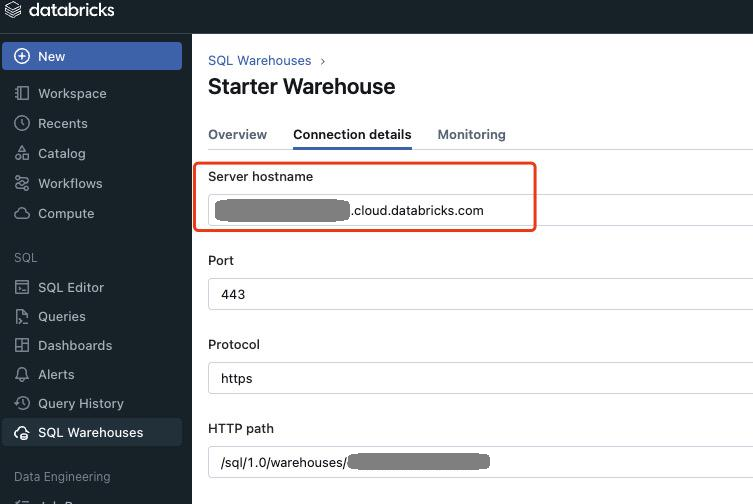
The auth setup is identical to the Databricks Delta Lake tutorial. Pick a PAT or OAuth M2M service principal and note your workspace's Server Hostname from the SQL Warehouse's Connection details tab.
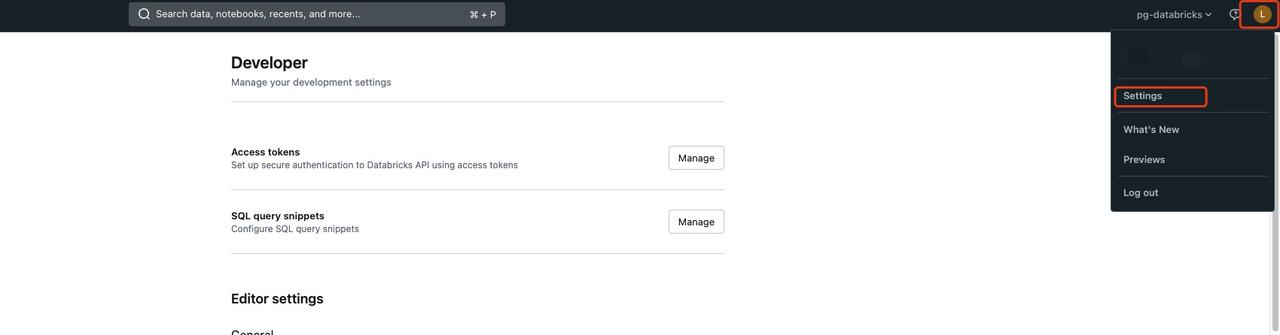
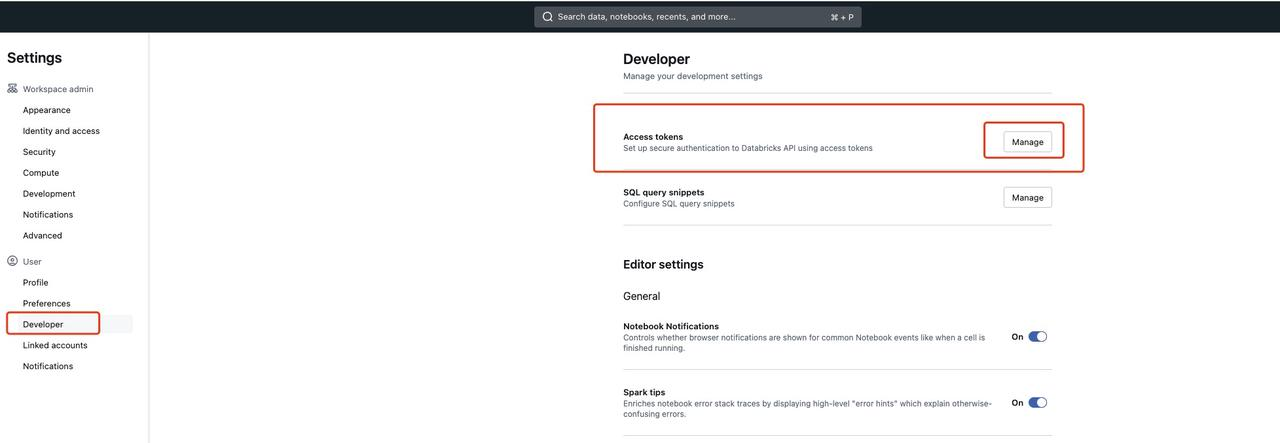
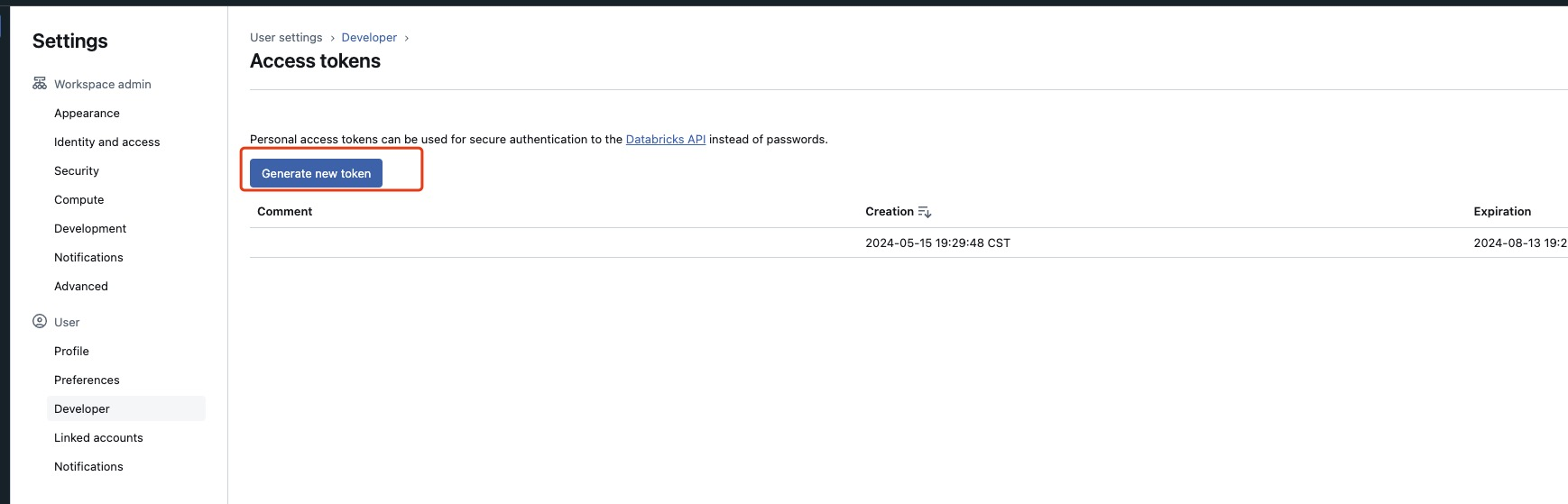
For PAT authentication, use Settings > Developer > Access tokens.
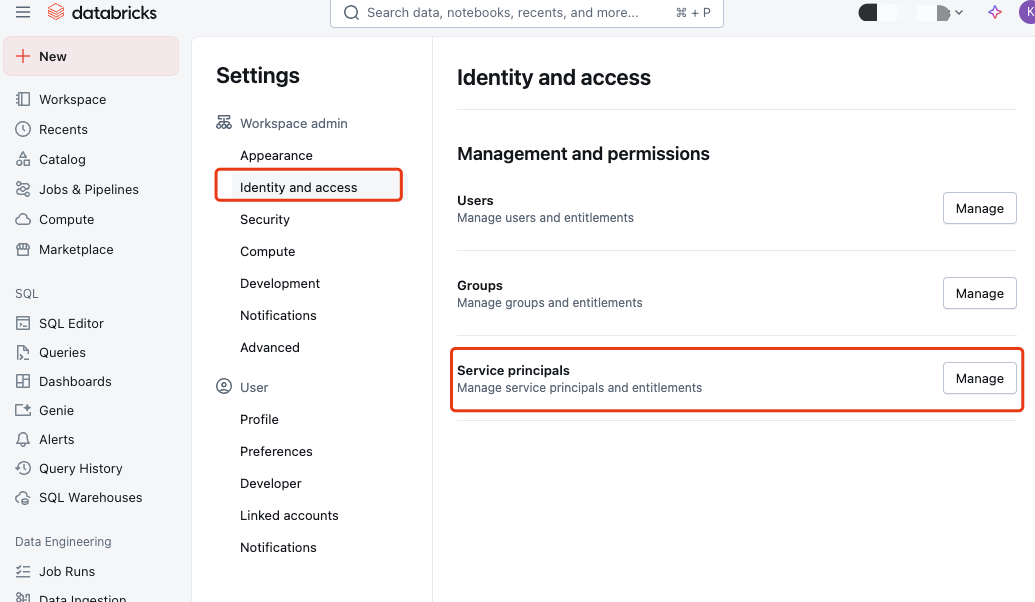
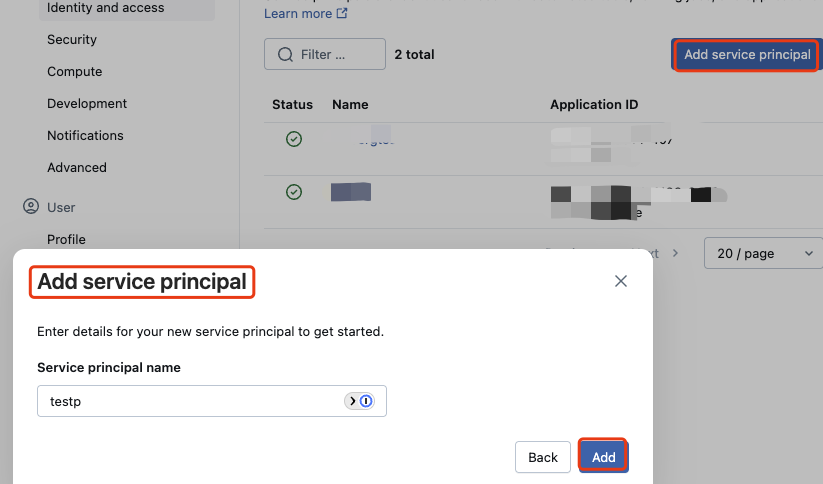
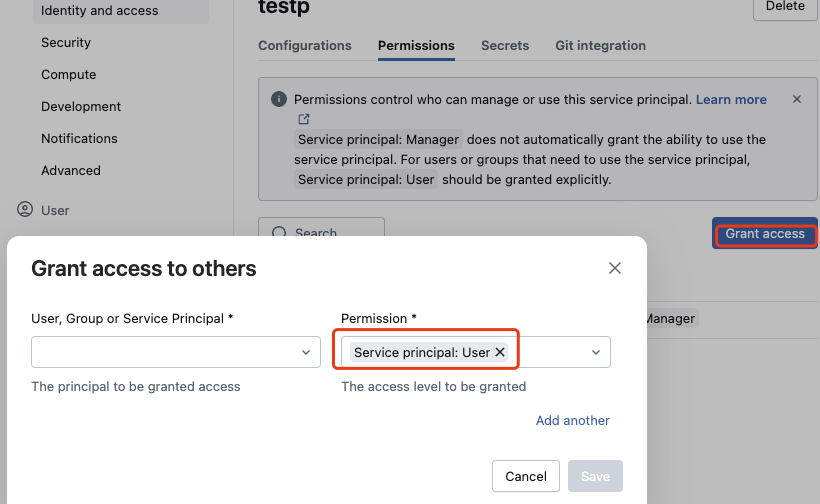
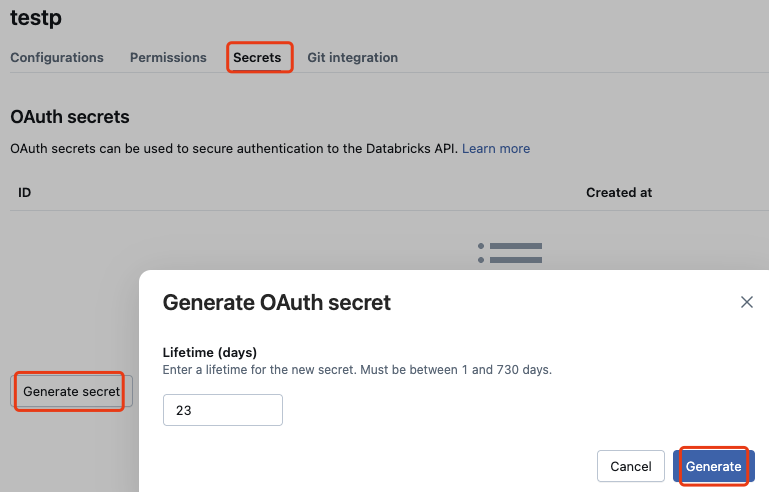
For OAuth M2M authentication, use Identity and access > Service principals.
Start PuppyGraph
Start the PuppyGraph container:
docker run -d --name puppygraph \
  -p 8081:8081 -p 8182:8182 -p 7687:7687 \
  -e PUPPYGRAPH_USERNAME=puppygraph \
  -e PUPPYGRAPH_PASSWORD=puppygraph123 \
  --pull=always puppygraph/puppygraph:latest
Default password
Change PUPPYGRAPH_PASSWORD before running on a publicly accessible machine.
Modeling a Graph
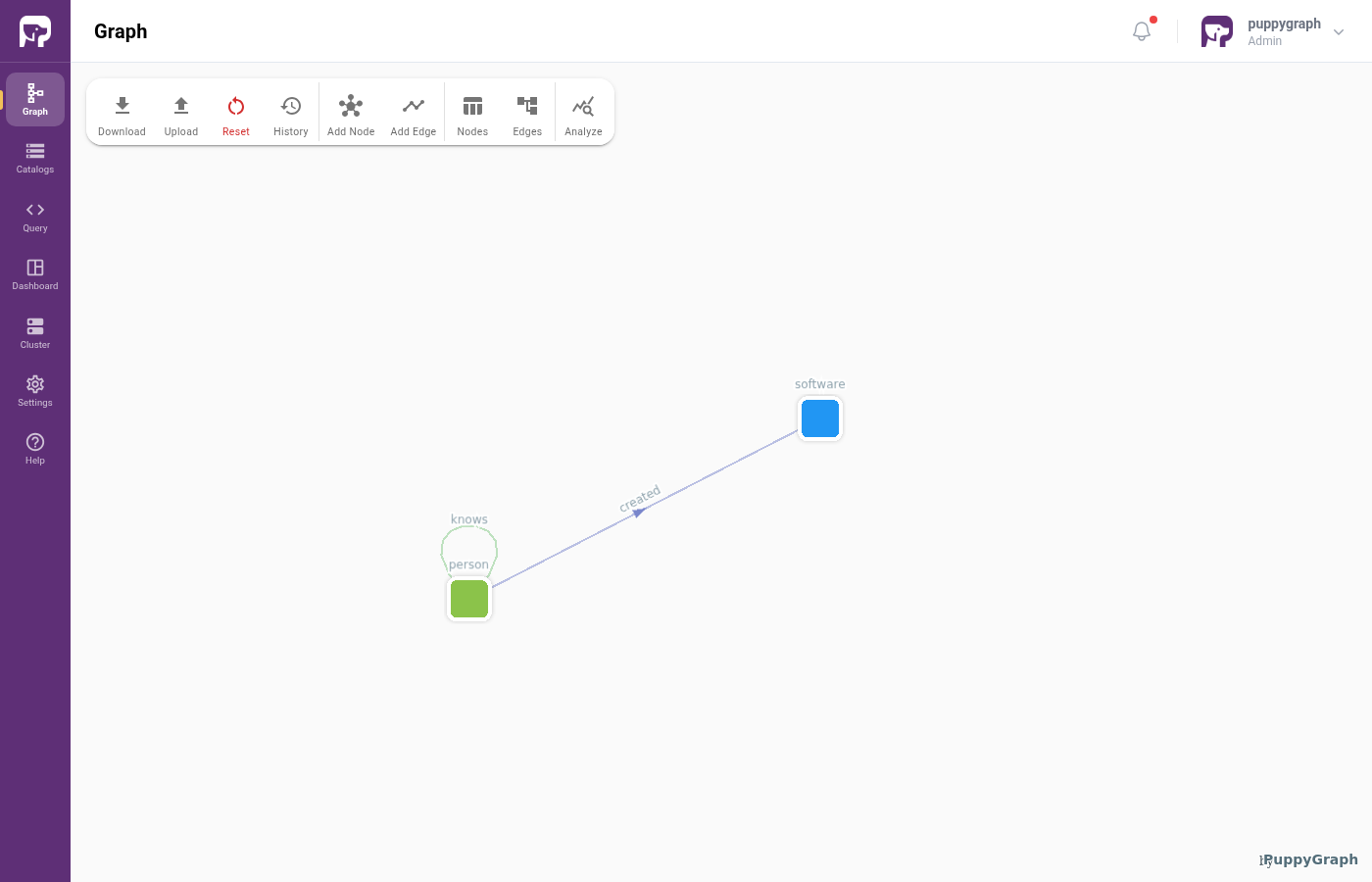
We model the data as the TinkerPop modern graph: two node types (person, software) and two edge types (knows, created).
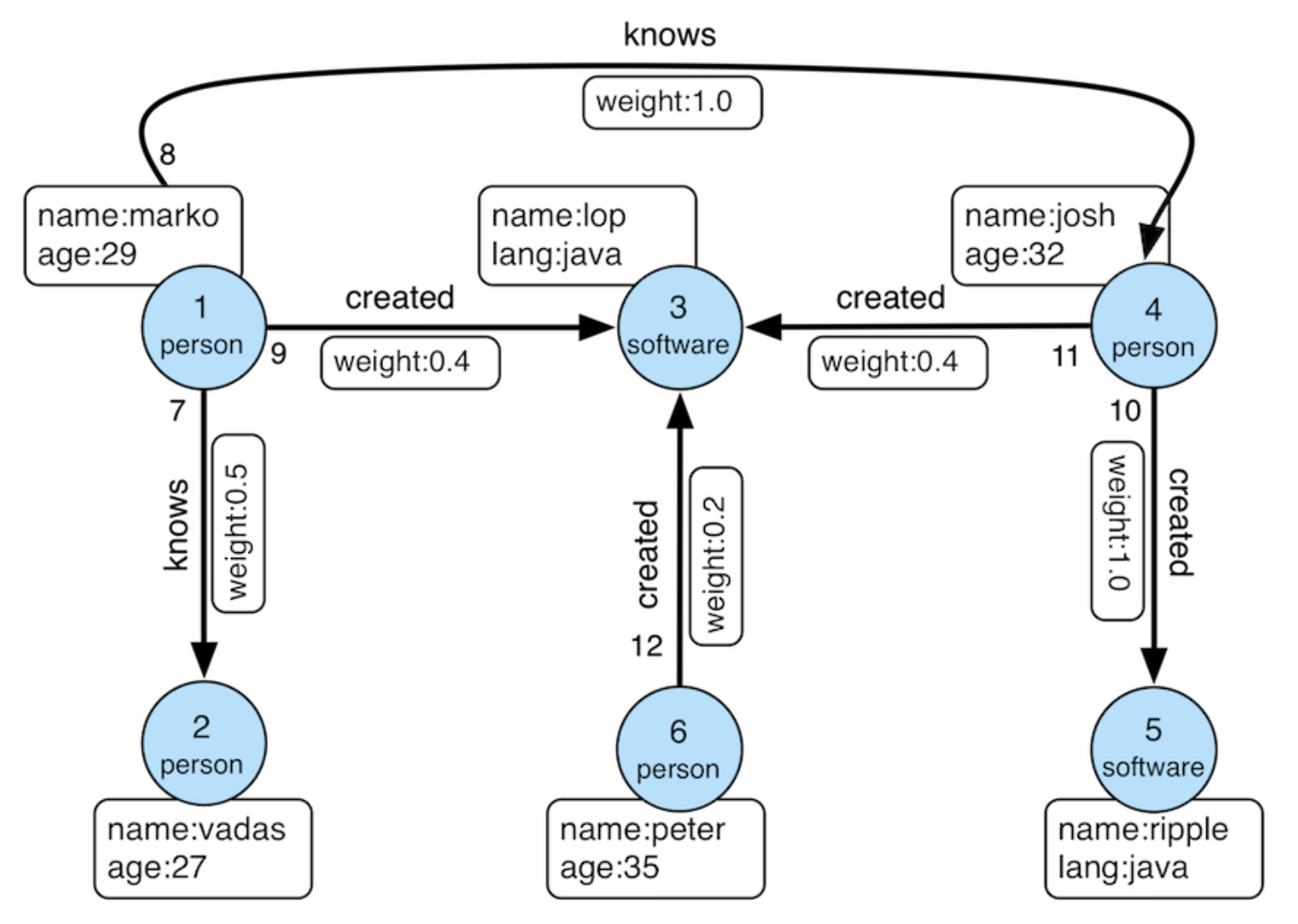
Log into the PuppyGraph Web UI at http://localhost:8081 with puppygraph / puppygraph123.
Build the graph in the Schema Builder
Click Create Catalog, then expand Data Lakes and pick Apache Iceberg.
Fill in the connection form using your Databricks workspace details. The form is the same as for Databricks Delta Lake; only the Catalog type at the top changes.
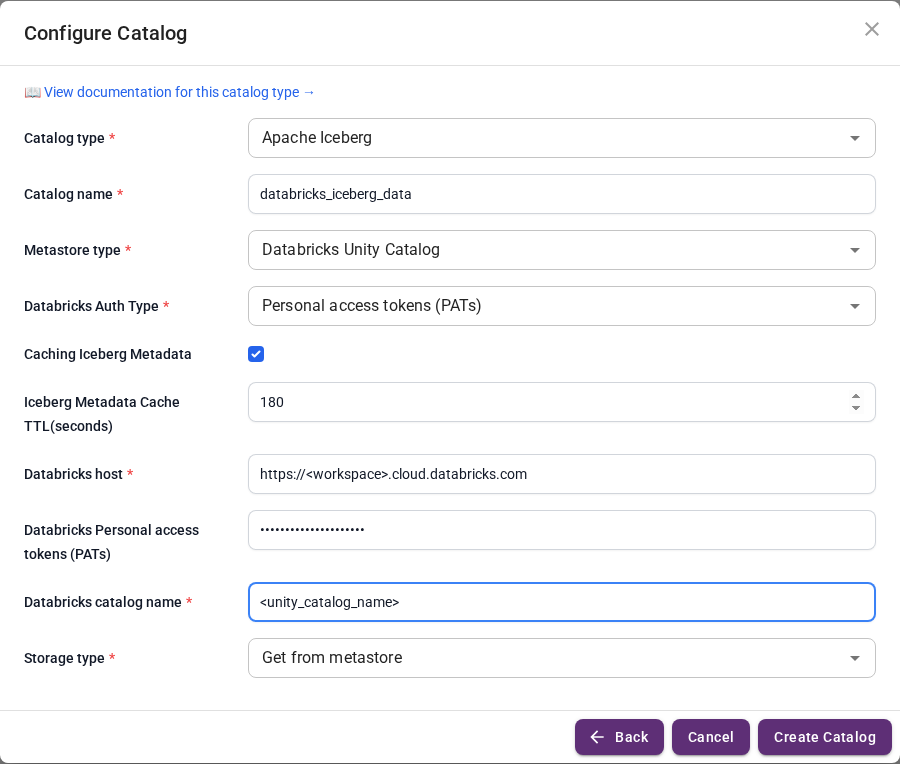
Click Create Catalog.
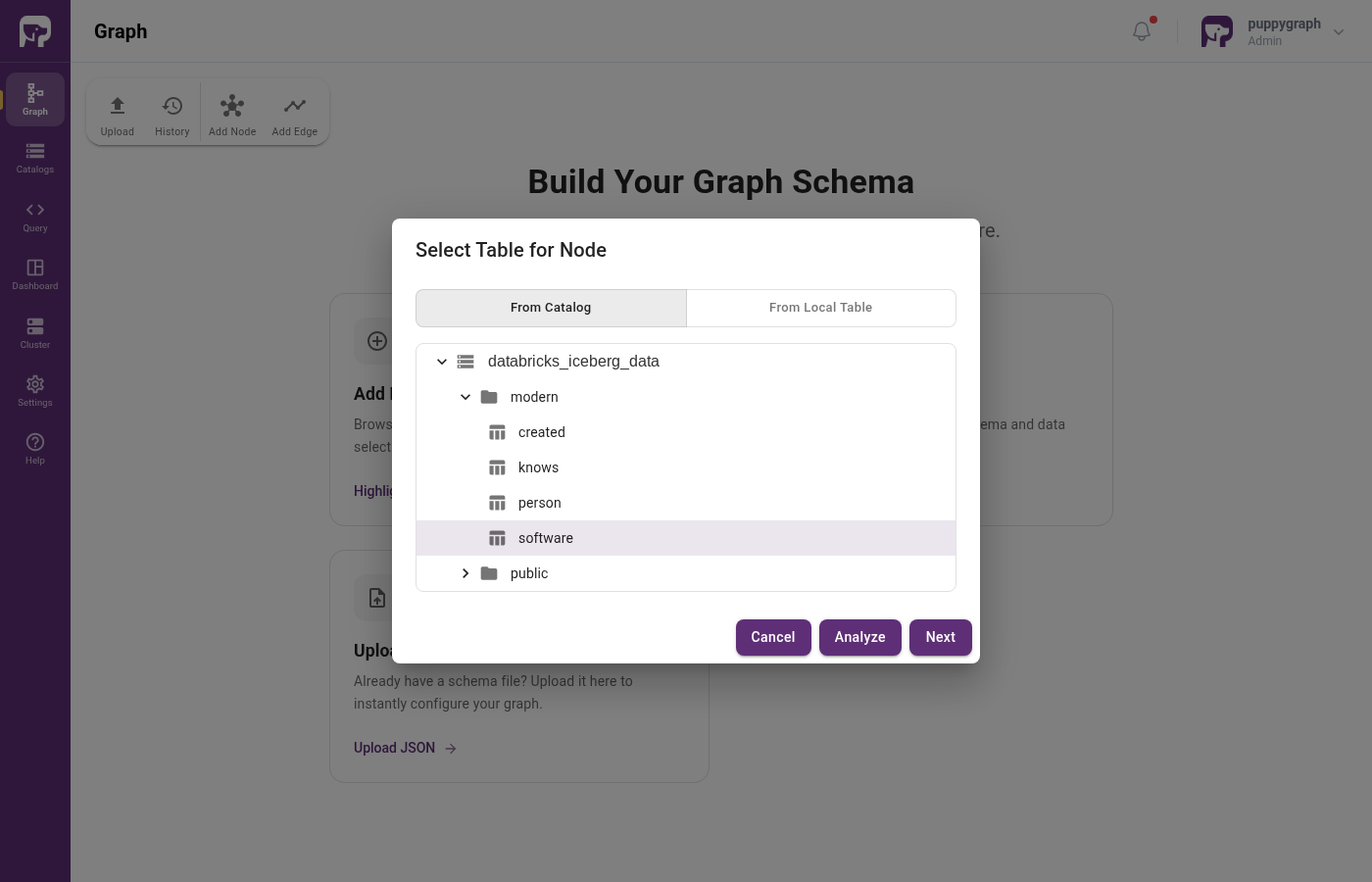
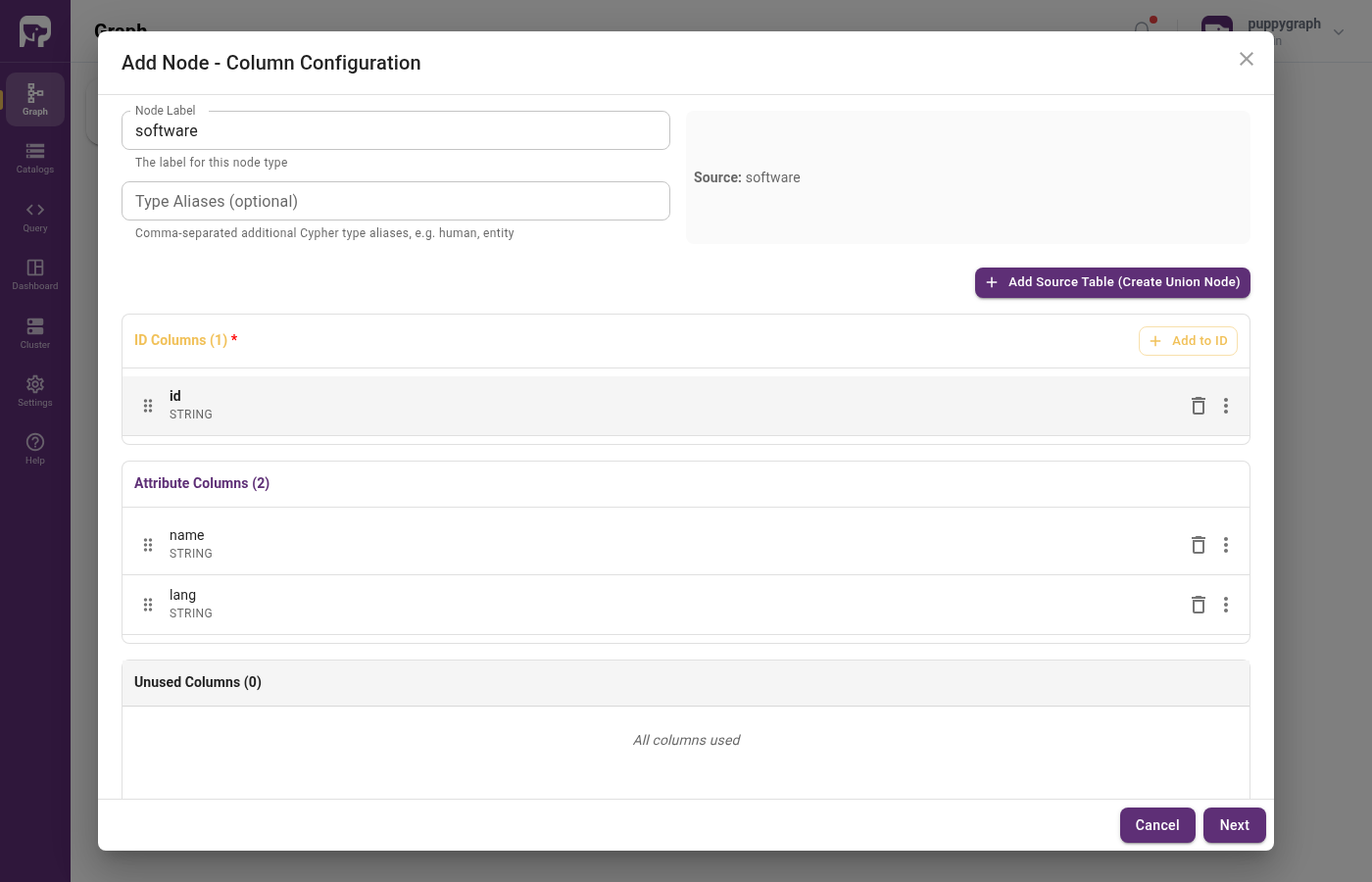
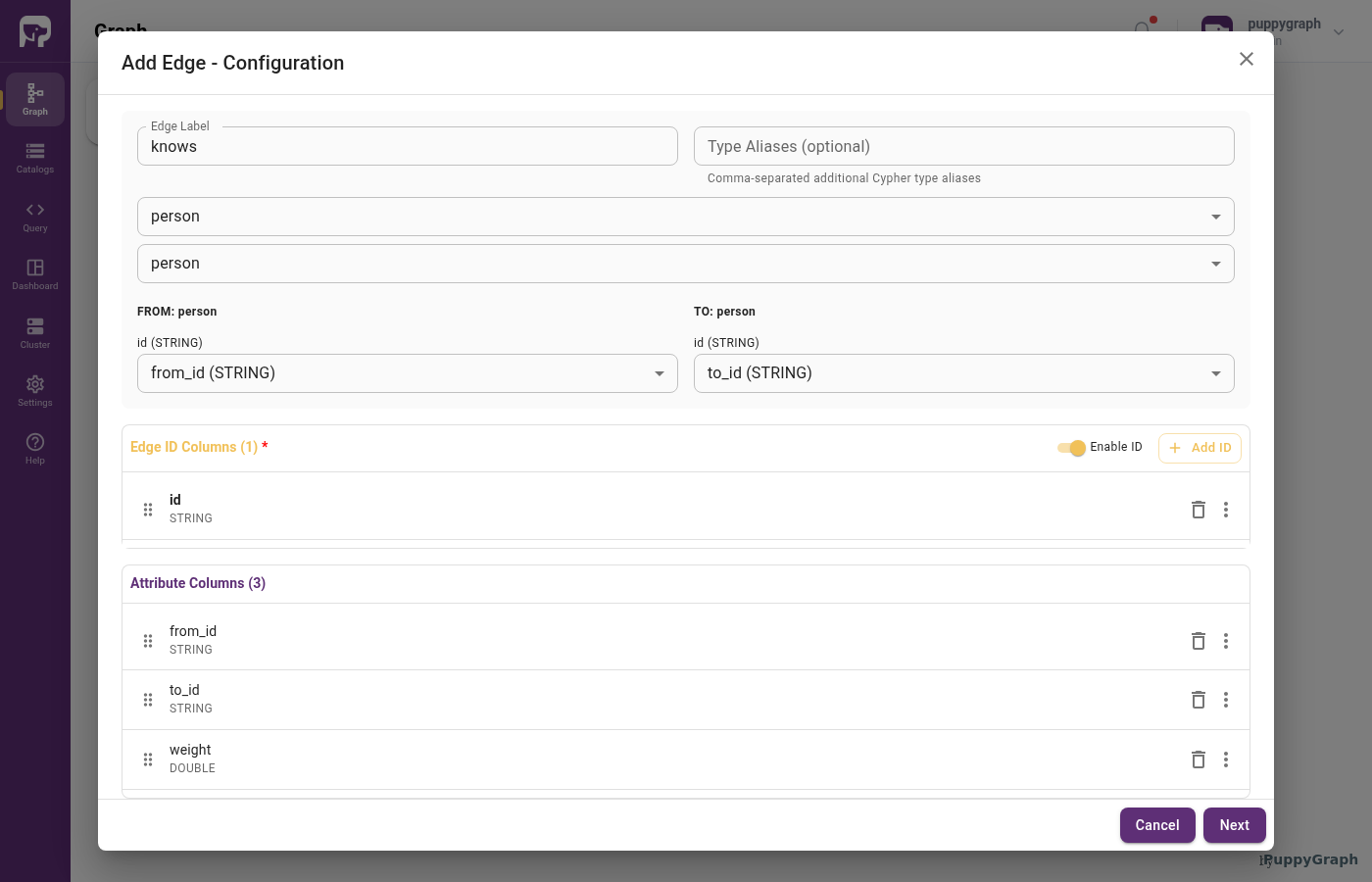
Add the software and person nodes, then the created and knows edges, the same way as in the Iceberg tutorial.
Upload a schema file
Create a file schema.json with the following content. Replace the host, catalog name, and credentials with your workspace's values:
schema.json (PAT auth)
{
  "catalog": [
    {
      "name": "databricks_iceberg_data",
      "type": "iceberg",
      "metastore": {
        "type": "unity",
        "host": "https://<workspace>.cloud.databricks.com",
        "token": "<your_databricks_pat>",
        "databricksCatalogName": "<unity_catalog_name>"
      }
    }
  ],
  "node": [
    {
      "label": "software",
      "dataSourceGroup": {
        "externalDataSource": {
          "enabled": true,
          "catalog": "databricks_iceberg_data",
          "schema": "modern",
          "table": "software",
          "mappedField": [
            { "sourceFieldName": "id",   "targetFieldName": "id"   },
            { "sourceFieldName": "name", "targetFieldName": "name" },
            { "sourceFieldName": "lang", "targetFieldName": "lang" }
          ]
        }
      },
      "id":        [{ "name": "id",   "type": "STRING" }],
      "attribute": [
        { "name": "name", "type": "STRING" },
        { "name": "lang", "type": "STRING" }
      ]
    },
    {
      "label": "person",
      "dataSourceGroup": {
        "externalDataSource": {
          "enabled": true,
          "catalog": "databricks_iceberg_data",
          "schema": "modern",
          "table": "person",
          "mappedField": [
            { "sourceFieldName": "id",   "targetFieldName": "id"   },
            { "sourceFieldName": "name", "targetFieldName": "name" },
            { "sourceFieldName": "age",  "targetFieldName": "age"  }
          ]
        }
      },
      "id":        [{ "name": "id",   "type": "STRING" }],
      "attribute": [
        { "name": "name", "type": "STRING" },
        { "name": "age",  "type": "INT"    }
      ]
    }
  ],
  "edge": [
    {
      "label":         "created",
      "fromNodeLabel": "person",
      "toNodeLabel":   "software",
      "dataSourceGroup": {
        "externalDataSource": {
          "enabled": true,
          "catalog": "databricks_iceberg_data",
          "schema": "modern",
          "table": "created",
          "mappedField": [
            { "sourceFieldName": "id",      "targetFieldName": "id"      },
            { "sourceFieldName": "from_id", "targetFieldName": "from_id" },
            { "sourceFieldName": "to_id",   "targetFieldName": "to_id"   },
            { "sourceFieldName": "weight",  "targetFieldName": "weight"  }
          ]
        }
      },
      "id":        [{ "name": "id",      "type": "STRING" }],
      "fromKey":   [{ "name": "from_id", "type": "STRING" }],
      "toKey":     [{ "name": "to_id",   "type": "STRING" }],
      "attribute": [
        { "name": "from_id", "type": "STRING" },
        { "name": "to_id",   "type": "STRING" },
        { "name": "weight",  "type": "DOUBLE" }
      ]
    },
    {
      "label":         "knows",
      "fromNodeLabel": "person",
      "toNodeLabel":   "person",
      "dataSourceGroup": {
        "externalDataSource": {
          "enabled": true,
          "catalog": "databricks_iceberg_data",
          "schema": "modern",
          "table": "knows",
          "mappedField": [
            { "sourceFieldName": "id",      "targetFieldName": "id"      },
            { "sourceFieldName": "from_id", "targetFieldName": "from_id" },
            { "sourceFieldName": "to_id",   "targetFieldName": "to_id"   },
            { "sourceFieldName": "weight",  "targetFieldName": "weight"  }
          ]
        }
      },
      "id":        [{ "name": "id",      "type": "STRING" }],
      "fromKey":   [{ "name": "from_id", "type": "STRING" }],
      "toKey":     [{ "name": "to_id",   "type": "STRING" }],
      "attribute": [
        { "name": "from_id", "type": "STRING" },
        { "name": "to_id",   "type": "STRING" },
        { "name": "weight",  "type": "DOUBLE" }
      ]
    }
  ]
}
For OAuth M2M, replace the catalog's metastore block with:
"metastore": {
  "type": "unity",
  "host": "https://<workspace>.cloud.databricks.com",
  "databricksCatalogName": "<unity_catalog_name>",
  "oauthClientId": "<service_principal_client_id>",
  "oauthClientSecret": "<service_principal_client_secret>"
}
In the Web UI, click Graph in the sidebar, then Upload Schema, and select schema.json.
Upload via CLI
Querying the Graph
In the PuppyGraph Web UI, click Query in the sidebar. You can run graph queries in either Cypher or Gremlin.
The following query answers "What software was created by people that marko knows?"
Cleanup
Stop the PuppyGraph container:
Drop the demo Iceberg tables from Databricks when you're done.